
Have you ever noticed a map-like web of blue or red lines spreading across your calves, or felt a persistent, heavy ache in your legs after standing all day? You are not alone. Millions of people worldwide experience some form of vein trouble. However, when looking at varicose veins vs spider veins, a lot of confusion arises around the distinct conditions that affect our vascular systems.
In this comprehensive, medically backed guide, we will break down both conditions, varicose veins vs spider veins, evaluate their potential health risks, detail the most effective treatment options, and explain how the specialists at Karishma Vein Clinic in Pune can help you restore the health and appearance of your legs.
Varicose Veins vs Spider Veins: What Is the Difference?
When comparing varicose veins vs spider veins, the distinction comes down to size, depth, appearance, and physical symptoms. While both stem from underlying venous insufficiency, a condition where the tiny valves inside your veins weaken and fail to pump blood back up to your heart efficiently, they manifest in completely different ways.
To truly understand the difference between spider veins and varicose veins, let’s look at their physical characteristics:
- Spider Veins: These are small, thin, thread-like blood vessels visible right beneath the surface of the skin. They often look like delicate tree branches or spider webs. Typically, they are red, purple, or blue, and measure less than 3 millimetres in diameter. While they can occasionally itch or cause mild burning, they are primarily cosmetic concerns.
- Varicose Veins: These are much larger, deeper, and physically protrude from the skin. They appear swollen, twisted, and rope-like, often dark blue or purple. Because they involve larger, deeper veins under higher pressure, they are often accompanied by physical symptoms such as aching, throbbing, swelling, skin changes, and a heavy feeling in the legs.
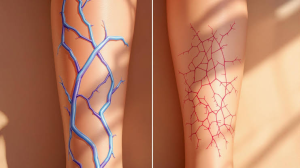
What is the Difference Between Spider Veins and Varicose Veins?
The table below outlines the primary functional differences between spider veins and varicose veins.
Feature | Varicose Veins | Spider Veins |
Size & Appearance | Large, raised, thick, bulging, and twisted. | Small, thin, flat, and web-like. |
Location | Mostly deep in the legs, calves, and ankles. | Legs, ankles, and frequently on the face. |
Primary Symptoms | Aching, heaviness, throbbing, swelling, and itching. | Typically asymptomatic; primarily a cosmetic concern. |
Underlying Cause | Failure of larger saphenous vein valves. | Dilation of tiny superficial capillaries. |
Health Risks | Can lead to blood clots, ulcers, and bleeding if neglected. | Rarely dangerous; poses minimal physical risk. |
Main Treatments | Laser Treatment (EVLT), Surgery, Sclerotherapy. | Laser therapy, injection sclerotherapy. |
Exploring the Types of Varicose Veins
Not all bulging veins are the exact same. Knowing the specific types of varicose veins allows vascular specialists to tailor your treatment plan. The most common types include:
- Trunk Varicose Veins: These are the large, thick, rope-like veins that bulge close to the surface of the skin. They usually develop from the main superficial veins in your legs, such as the Great Saphenous Vein (GSV) or Small Saphenous Vein (SSV).
- Reticular Varicose Veins: Often called “feeder veins,” these are slightly thicker than spider veins (usually 1 to 3 mm) and sit a bit deeper under the skin. They form a greenish-blue network and often feed into spider veins.
- Accessory Saphenous Varicose Veins: These develop in the branches that split off from your main trunk veins. They can cause similar bulging and physical discomfort.
- Pregnancy-Induced Varicose Veins: These often occur due to increased blood volume and hormonal changes during pregnancy and typically resolve on their own within 3 to 12 months after giving birth.
Is Varicose Veins Dangerous to Your Health?
Many people put off seeking medical attention, assuming that swollen veins are just a natural consequence of aging. But is varicose veins dangerous?
While a mild case might only cause aching, neglecting advanced varicose veins can lead to serious, chronic medical complications:
- Chronic Venous Insufficiency (CVI): Continuous pooling of blood damages leg tissues over time, causing persistent swelling, skin discolouration (hyperpigmentation), and hardening of the skin.
- Venous Ulcers: Due to poor circulation and fluid build-up, minor scratches on the lower legs can turn into painful, slow-healing open sores (ulcers) that are highly susceptible to infection.
- Superficial Thrombophlebitis: This is an inflammatory condition caused by a blood clot forming in a vein close to the surface of the skin, leading to redness, warmth, and localised pain.
- Deep Vein Thrombosis (DVT): In rare, severe cases, the sluggish blood flow in varicose veins can increase the risk of blood clots forming in the deep veins of your legs. If these clots break free, they can travel to the lungs, causing a life-threatening pulmonary embolism.
- Spontaneous Bleeding: Because varicose veins lie close to the skin’s surface under high pressure, even a minor bump or scratch can cause them to rupture, resulting in significant bleeding.
If you are experiencing swelling, skin changes, or pain that interferes with your daily activities, it is crucial to consult a vascular specialist rather than waiting for complications to arise.
Is Varicose Veins Curable?
One of the most frequent questions we receive from our patients is: is varicose veins curable?
The short answer is: Yes, varicose veins are highly treatable and curable, thanks to modern, minimally invasive medical procedures.
While damaged vein valves cannot be surgically repaired or rebuilt, we can safely close off the diseased veins. When we seal a failing vein, your body naturally reroutes the blood flow through healthier, deeper veins. Once the bad vein is closed, it gradually shrinks, dissolves, and is safely absorbed by the body.
While you cannot change genetic factors that make you prone to developing new vein problems in the future, modern treatments offer a highly effective, long-term cure for your existing damaged veins.
Modern, Non-Surgical Treatments for Vein Relief
Gone are the days when painful vein stripping surgeries with long hospital stays were the only solution. Today’s state-of-the-art medical procedures are quick, highly effective, and require virtually no downtime.
1. Endovenous Laser Treatment (EVLT)
For larger, trunk varicose veins, EVLT is the best choice . Using US FDA-approved laser technology, a tiny laser fiber is inserted directly into the damaged vein under local anaesthesia. The laser energy heats and safely seals the vein from the inside out. The procedure takes under an hour, is virtually pain-free, and lets you walk out of the clinic the very same day.
2. Injection Sclerotherapy
For spider veins and smaller reticular veins, the most widely trusted solution is injection sclerotherapy.
During a standard sclerotherapy procedure, a highly skilled specialist uses an ultra-fine needle to inject a mild chemical solution directly into the targeted vein. This solution gently irritates the lining of the blood vessel, causing it to stick together, collapse, and shut down. Over the following weeks, your body naturally absorbs the closed vessel, leaving your skin clear and spot-free. The entire process takes just 15 to 30 minutes, is performed right in the clinic, and involves minimal discomfort.
Key benefits of the sclerotherapy procedure include:
- No surgical incisions required.
- Performed as an outpatient procedure, usually within 30 minutes.
- Minimal downtime — most patients resume daily activities the same day.
- Effective for both cosmetic spider veins and small to medium varicose veins.
- Often combined with laser treatment for comprehensive results in more advanced cases.
For larger varicose veins, our specialists typically recommend Endovenous Laser Treatment (EVLT) first, followed by sclerotherapy for any remaining smaller veins. giving patients smoother, more complete results.
Why Do Many Patients Trust Karishma Vein Clinic for Varicose Veins Treatment in Pune?
Choosing the right clinic makes all the difference when it comes to vein health. Here’s what sets us apart:
- 25 years of clinical excellence, with a legacy built since 1999 under Dr. Suresh Sanghvi
- Over 1,000 successfully treated cases, backed by consistently strong patient outcomes
- Advanced, US FDA-approved Diode Laser technology from Biolitec, Germany
- A skilled, multidisciplinary team including general and plastic surgeons and cosmetology specialists
- Both surgical and non-surgical options, including EVLT and injection sclerotherapy, tailored to each patient
- Insurance, EMI, and Mediclaim support to make treatment more accessible
- A clean, comfortable, patient-first environment in the heart of Pune
- Consistently high patient satisfaction, reflected in hundreds of positive reviews
Ready to Take the First Step Toward Healthier Legs?
Whether you’re dealing with the visible discomfort of varicose veins or simply want to address spider veins for cosmetic reasons, you don’t have to live with it. Our specialists at Karishma Vein Clinic will assess your condition, explain your options clearly, and guide you toward the safest, most effective treatment for your needs.
Contact Karishma Vein Clinic:
- Phone: +91 078149 91992
- Email: [email protected]
- Address: 233, Sunrise Plaza, 3rd Floor, Above ICICI Bank, Near Kohinoor Hotel, MG Road, Pune, Maharashtra 411001
Click Here to Book Your Appointment Online Today.
FAQs
Varicose veins are larger, raised, and often cause discomfort like heaviness or aching, while spider veins are small, flat, thread-like veins that sit closer to the skin’s surface and are usually painless. Varicose veins result from deeper valve dysfunction, whereas spider veins are typically more superficial and cosmetic in nature.
It depends on the size and depth of the affected veins. Laser treatment (EVLT) works best for larger, trunk varicose veins, while injection sclerotherapy is highly effective for smaller varicose veins and spider veins. In many cases, a combination of both provides the most complete and lasting results. A proper evaluation by a vein specialist is the best way to determine which approach suits you.
In many cases, varicose veins remain a mild, manageable issue. However, if left untreated for a long time, they can lead to complications such as skin changes, venous ulcers, inflammation, or in rare cases, blood clots. Getting an early evaluation helps prevent these risks from developing.
Most patients describe injection sclerotherapy as causing only mild, brief discomfort, similar to a small pinch, rather than significant pain. During the procedure, a solution is injected into the vein, causing it to gradually collapse and fade. It’s a quick, outpatient procedure with little to no downtime.
Non-surgical treatments like sclerotherapy and laser therapy can effectively close off and eliminate the treated veins, offering long-lasting, often permanent results for those specific veins. However, because venous disease can be influenced by genetics and lifestyle, new veins may occasionally develop elsewhere over time — which is why periodic follow-up is recommended.

Dr. Sanghvi
A Premier board-certified Cosmetic & Plastic Surgeon and co-founder of Karishma Vein Clinic. Backed by an experienced medical team and an elite advisory panel of visiting experts from Mumbai, Dr. Sanghvi specializes in advanced vein and body contouring treatments.
The Clinic is globally recognized, drawing international patients to its state-of-the-art facility equipped exclusively with FDA-approved, ultra-modern technologies like the Contra Diode Endovenous Laser. Under his trusted clinical leadership, patients receive world-class, customized care for both surgical and non-surgical aesthetic transformations.